[de] Liebesakt;
Innenbild einer Rotfigurigen Trinkschale des Triptolemos-Malers, um 470 v.Chr.; Museo Nazionale Tarquinia.
[en] Sexual act.
Tondo of an Attic red-figure kylix by the Triptolemos painter, ca. 470 BC, Museo Nazionale Tarquinia, ARV 367,94.
Showing posts with label flute-girl. Show all posts
Showing posts with label flute-girl. Show all posts


Welche Bedeutung hat der Korb? |
What meaning has the basket?
[de] Ein Paar kurz vor einem Kuß während eines Gelages;
Innenbild einer Rotfigurigen Trinkschale um 500 v. Chr.; Yale University Art Galery New Haven, 1913.163 source: Angelika Dierichs: Erotik in der Kunst Griechenlands. von Zabern, Mainz 1997 (Zaberns Bildbände zur Archäologie) ISBN 3-8053-2014-0
[fr] Couple allongé, sur le point de s'embrasser.
Dessin intérieur d'une coupe à figures rouges. Vers 500 avjc

Innenbild einer Rotfigurigen Trinkschale um 500 v. Chr.; Yale University Art Galery New Haven, 1913.163 source: Angelika Dierichs: Erotik in der Kunst Griechenlands. von Zabern, Mainz 1997 (Zaberns Bildbände zur Archäologie) ISBN 3-8053-2014-0
[fr] Couple allongé, sur le point de s'embrasser.
Dessin intérieur d'une coupe à figures rouges. Vers 500 avjc
Hetäre oder Flötenmädchen? |
Hetaera or flute-girl?
[de] Eine für einen Symposianten tanzende Hetäre{?}.
Innenbild einer attischen rotfigurigen Trinkschale, um 490-480 v. Chr. Aus Vulci.
[en] Symposium scene: a reclining youth holds an aulos in one hand and gives another one {which other one?} to a female dancer. {A flute case at the Wall?}
Kalos inscription: "PILIPOS KALLISTO" (Philip is the most beautiful).
Tondo from an Attic red-figured kylix, ca. 490-480 BC. From Vulci.
[fr] Scène de banquet : un jeune homme allongé tient un aulos dans une main et en tend un autre à une danseuse.
Inscription kalos : « Philippe est le plus beau ».
Intérieur d'un kylix attique à figures rouges, vers 490-480 av. J.-C. Provenance : Vulci.

Innenbild einer attischen rotfigurigen Trinkschale, um 490-480 v. Chr. Aus Vulci.
[en] Symposium scene: a reclining youth holds an aulos in one hand and gives another one {which other one?} to a female dancer. {A flute case at the Wall?}
Kalos inscription: "PILIPOS KALLISTO" (Philip is the most beautiful).
Tondo from an Attic red-figured kylix, ca. 490-480 BC. From Vulci.
[fr] Scène de banquet : un jeune homme allongé tient un aulos dans une main et en tend un autre à une danseuse.
Inscription kalos : « Philippe est le plus beau ».
Intérieur d'un kylix attique à figures rouges, vers 490-480 av. J.-C. Provenance : Vulci.
Welche Bedeutung hat der knorrige Gehstock? |
What meaning has the knobby walking cane?
[en] Aulos player.
Attic red-figured kylix, ca. 490 BC. From Vulci.
[fr] Joueur d'aulos.
Kylix attique à figures rouges, vers 490 av. J.-C. Provenance : Vulci.
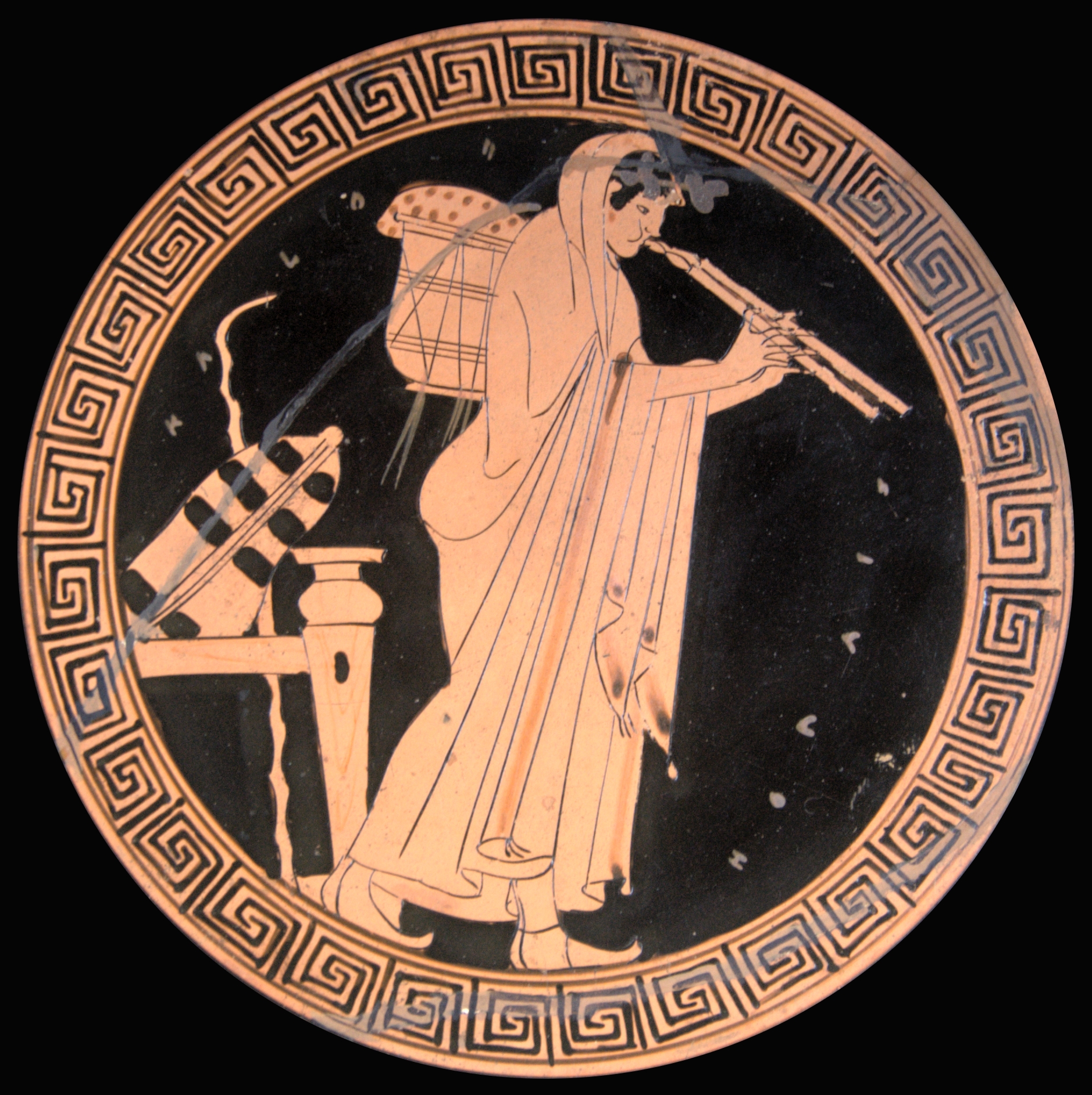
Attic red-figured kylix, ca. 490 BC. From Vulci.
[fr] Joueur d'aulos.
Kylix attique à figures rouges, vers 490 av. J.-C. Provenance : Vulci.
Subscribe to:
Posts (Atom)


 Posts
Posts


